
Four brand and marketing insights from our team, delivered every month.

Your Conversions Dropped in April. Here’s Why.
In April, a WA business owner sent their monthly marketing report to me and asked a fair question: why were conversions down fifteen percent when nothing about the business had changed? And they were right, nothing about the business had changed. Rather, it was Google that changed.
That month, Google rebuilt how GA4 credits conversions. It retired first-click attribution entirely and migrated accounts onto a new data-driven model, mostly without telling anyone. The catch is volume: the new model needs a certain amount of conversion data to work, and accounts below that threshold were dropped back to last-click, where the final tap before a sale takes all the credit and the channels that did the early work get none.
That describes most businesses in WA. So a lot of WA reports show the same April dip, and it has nothing to do with how the marketing actually performed. The scorekeeping changed underneath for everyone at once.
Worth knowing if your own numbers wobbled this quarter. Before you cut a channel that suddenly looks weak, check whether it’s the channel that changed or just the way Google is counting it.
Read Evan’s full breakdown on the Bonfire blog →
// Evan Dela-Grammaticas, Senior Strategist

Always-On, Not Always Converting?
Over my 10+ year career, shopping and buying behaviour have completely shifted. Shoppers do something that goes against most media plans: they wait.
The Australia Post eCommerce Report 2026 puts numbers on what I see in the data every week. 73% of Australians hold out for a sales event before buying. Among Gen Z it’s 96%. They’ve trained themselves to expect a discount, and they’re patient enough to get one.
That changes what a paid ad is actually for. If most of your audience has already decided to wait for a price signal, an ad shown to them in a quiet week isn’t converting anyone. It’s paying to remind people of a purchase they’re going to delay anyway. The conversion happens later, on the shopper’s timeline, not mine.
So I’ve stopped treating always-on as the goal and started treating it as the warm-up. The work is priming demand in the weeks before a peak, so when the sale lands, the audience is already there. The decision’s been made. I just need to be the brand they remember.
// Madison Forward, Performance Media Team Leader
The Art of Making SEO Look Unplanned
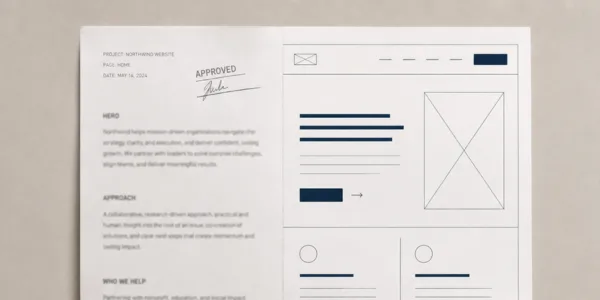
Somewhere along the way, SEO content got dressed in a grey tracksuit. H1. Paragraph. H2. Paragraph. A few internal links. A flat FAQ section at the bottom. Maybe a stock image if everyone was feeling ambitious. Technically, the page had been optimised. Emotionally, it had been abandoned.
Part of my job is the step most people think of as admin: taking approved copy and putting it live. But a page does not rank, persuade or build trust as a Word document. It does that as a live experience.
So the recommendations I work from have stopped reading like “add this text” and started reading like architecture. This proof point should sit near the CTA. This comparison would be stronger as a table. This FAQ should be an accordion. This service block should borrow an existing module rather than be forced into plain text.
That is a small change that hides a big one. The question is no longer what content goes on a page. It’s what the page should become. And the highest compliment for the result is never “that’s very optimised.” It’s “this feels like it was always meant to be here.”
Dig into Michael’s full case for building the page around the content →
// Michael Chen, Technical SEO Lead

What Tasmania Taught Me About Daily Metrics
I’m in Tasmania. My first trip was in 2023, and I’ve been dreaming of coming back ever since. We arrived on Monday after a rough ferry crossing, the kind that makes you question your life choices halfway across the strait.
After spending the last few months travelling through Melbourne, Sydney and Brisbane, one thing that really stands out about Tasmania is the slower pace. Nothing feels driven by urgency. The people and the wildlife move on their own terms, paced by environment rather than pressure.
In digital marketing we operate the opposite way. We monitor rankings, respond to traffic spikes, optimise in real time. A lot of that daily movement is just weather, though. The things that actually decide whether a brand thrives — its authority, its trust and the loyalty of the people who already know it — move on a much slower clock.
So I’ve started paying less attention to the daily swings and more to the health of the whole system. Reacting to every fluctuation doesn’t strengthen anything. The growth I actually care about is slow, and it rewards patience over urgency.
// Lydia Barley, Digital Marketing Specialist
Bonfire is an award-winning performance marketing agency based in Subiaco, Western Australia.